Why Your Seedlings Are Leggy and How to Fix It
Stretched, pale, floppy seedlings are almost always chasing light. Here is how to read the signs and correct light, spacing, warmth and airflow before it costs you the season.

Every spring the same message arrives: the tomatoes are up, and they look like they are running away from the tray. Long pale stems, two small leaves at the top, and a lean that suggests the whole flat is about to topple. Nothing has gone catastrophically wrong. The seedlings are leggy, which is the plant's way of telling you it is short of something, usually light, and stretching to find it.
Legginess is one of the few garden problems you can diagnose by eye in about three seconds. That also means you can often correct it before the season is lost. What follows is what is actually happening inside those stems, and the four levers worth adjusting.
What a leggy seedling is telling you
Look closely at the stem. On a strong seedling, the stretch of stem between one pair of leaves and the next is short, often less than a centimetre on a young tomato. The leaves stack up close together, they are broad for their size, and the stem is thick enough that the plant stands without help. On a leggy seedling, those gaps are long, the stem is thin and pale, the leaves are small and spaced far apart, and the whole thing leans toward the nearest window.
That response has a name, etiolation, and it is a survival strategy rather than a disease. A seed germinates with a fixed amount of stored energy. If the light it finds is weak, it spends that energy on stem length instead of leaf area, gambling on reaching brighter conditions. In a garden that gamble works. On a windowsill, the plant simply stretches until it falls over.
The usual signs, in the order they appear:
- Long gaps between leaf pairs, with a stem that gets thinner toward the top
- Pale green or yellowish colour, especially on the lower stem
- Small leaves that never seem to expand
- Leaning hard in one direction, or flopping once the tray is watered
- Roots appearing at the base of the stem on tomatoes, peppers and similar crops
One honest caveat: not every tall seedling is failing. Onions, leeks, snapdragons and celery are naturally slender and upright. A tray that looks floppy two days after pricking out is usually just transplant shock. Judge the plant by stem thickness and leaf spacing, not by height alone.
Light, the usual suspect
A south-facing windowsill in late winter delivers a fraction of the light a seedling would get outdoors in May, and glass filters out much of what does arrive. The plant does not measure hours, it measures how much usable light lands on the leaf. Weak light for fourteen hours is still weak light.
Getting more from a windowsill
Move trays as close to the glass as you can, ideally within a few centimetres, and turn them a quarter turn every day or two so the stems do not commit to one direction. Wipe the inside of the glass; a surprising amount of light is lost to grime and condensation. If the windowsill is narrow and the tray deep, rotate which side faces the window rather than assuming the light reaches the back row. It does not. The back row will always be the leggiest one in the flat.
Warm rooms make this worse. A windowsill above a radiator gets heat without light, which is exactly the combination that produces pale, drawn stems.
Using grow lights without overcomplicating it
A simple fluorescent or LED bar a few inches above the seedlings will do more than any other single change. Keep the light close to the tops of the plants, two to four inches for most LED tubes, and raise it as they grow so the leaves never touch it. Aim for fourteen to sixteen hours a day, and use a cheap timer so you are not the weak link. Light intensity drops off quickly with distance, so hanging a lamp a foot above the tray gives you a fraction of what it gives at four inches.
Do not leave lights on around the clock. Most seedlings grow better and stockier with a dark period, and constant light on some crops causes leaf damage.
Sowing too thickly starts the race early
A crowded tray is a competition. Each seedling shades its neighbours, and every plant responds by stretching for the gap in the canopy. The problem feeds itself: the faster ones stretch, the more shade they cast, and the whole flat goes pale together.
Sow thinly and evenly, then thin or prick out as soon as the first true leaves appear, which is the pair after the initial seed leaves. Give each seedling its own cell or a small pot, with roughly three to five centimetres between plants while they are still small. Resist the urge to leave three seedlings in one module "just in case". They will not sort it out between themselves.
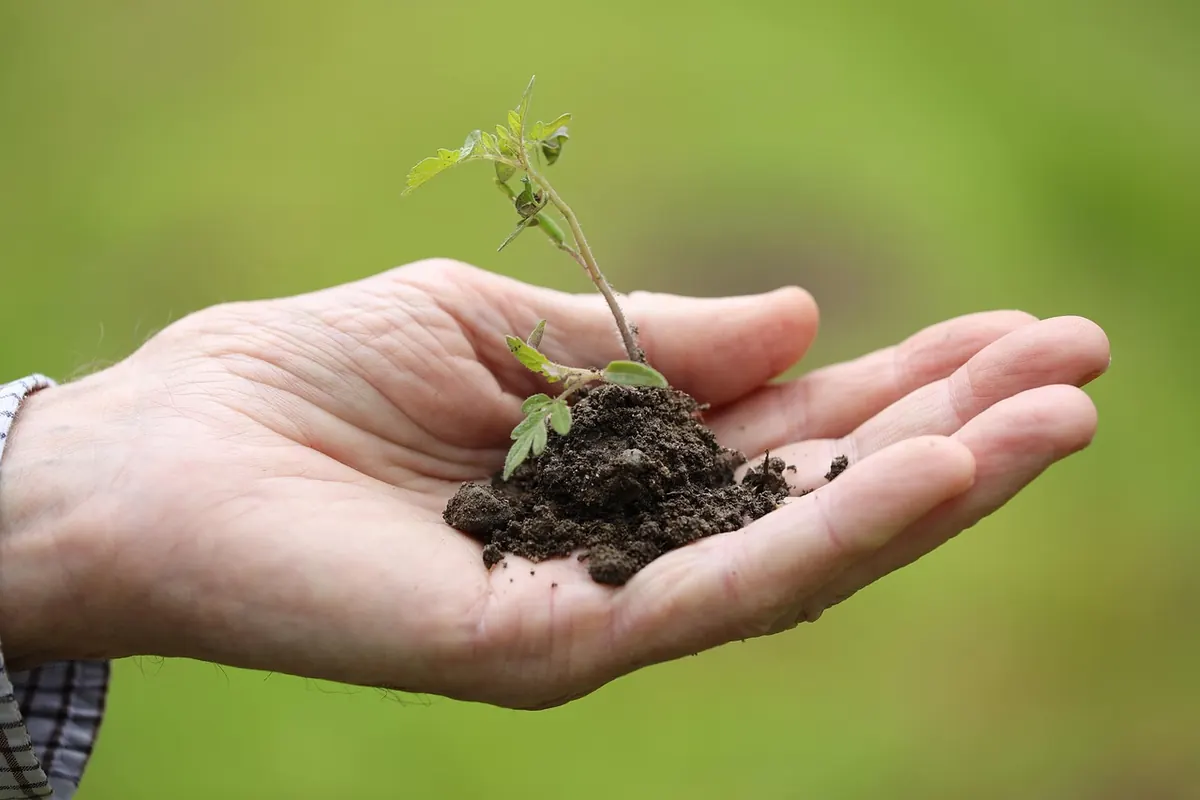
When you pot on, plant deeply. Tomatoes, peppers and most brassicas will root along a buried stem, so a leggy tomato can be set so that the stem up to the seed leaves sits below the compost line. That single trick turns a weak seedling into a sturdier plant with a better root system.
Warmth pushes growth the plant cannot support
Germination and growing on want different conditions, and mixing them up is a common cause of stretched seedlings. Most seeds sprout happily at around 21 to 24°C, which is why a heat mat or a warm cupboard works well for germinating. Once the seedlings are up, they need less warmth and more light.
Move trays off the heat mat as soon as the first seedlings break the surface, not when the whole tray is up. Then find the coolest bright spot you have, ideally somewhere in the mid-teens at night. Cooler nights slow stem extension while the days stay bright, which is precisely the ratio that builds a compact plant. A spare bedroom, a glazed porch or an unheated conservatory often beats a warm kitchen by a wide margin.
Still air makes weak stems
Stems thicken in response to movement. In a greenhouse or outdoors, every breeze bends the seedling slightly, and the plant answers by laying down stronger tissue. Indoors, in still air, there is no signal to do that, and the stems stay soft.
Run a small oscillating fan on the lowest setting, angled so it moves the air around the tray rather than blasting the leaves directly, for an hour or two a day. Brushing the seedlings lightly with your hand as you walk past has a similar effect and costs nothing. Moving air also keeps the foliage surface drier, which helps against damping off and fungus gnats, two problems that love a stagnant, overwatered tray.
Repairing seedlings that are already leggy
You cannot shorten a stem that has already stretched, but you can usually work around it. Bury the stem when you pot on. If a tomato has fallen over, lay the stem in a shallow trench and gently bend the top upward, covering all but the top few leaves with compost. Pot the plant deeper than it was growing and firm the compost around it, then water in.
Give the tray the brightest spot you have, close to the glass or under a lamp at the right height, and cut back on watering for a few days. Soft, fast-grown seedlings are easily rotted. Be honest about the weakest ones: a pale, pinched seedling with a thread of a stem rarely catches up, and a fresh sowing takes less time than nursing it back. A second sowing in early spring is cheap insurance.
A routine that prevents most of it
Once you have the four levers in mind, the routine is short and worth repeating every few days:
- Check the distance between the light and the tallest seedling, and raise the lamp only as far as you must.
- Turn the trays a quarter turn.
- Lift a pot to judge weight before watering, rather than watering on a schedule.
- Look for the first true leaves and prick out anything crowded.
- Give the flat an hour of moving air.
Stocky seedlings are not a matter of luck or a green thumb. They are what happens when light is bright and close, roots have room, nights are cool and the air is never quite still. Get those roughly right, and the trays that leave your windowsill in May will stand up on their own.
Photo: nattanan23 / Pixabay